AI is already forming a view of your business from two sides — your CRM on the inside, and how you're represented across the web on the outside. Optimising revenue operations for AI means making both tell the right story. It starts with an audit.
Two pictures of the same shift: what AI needs from your business now, and where buying is heading next.
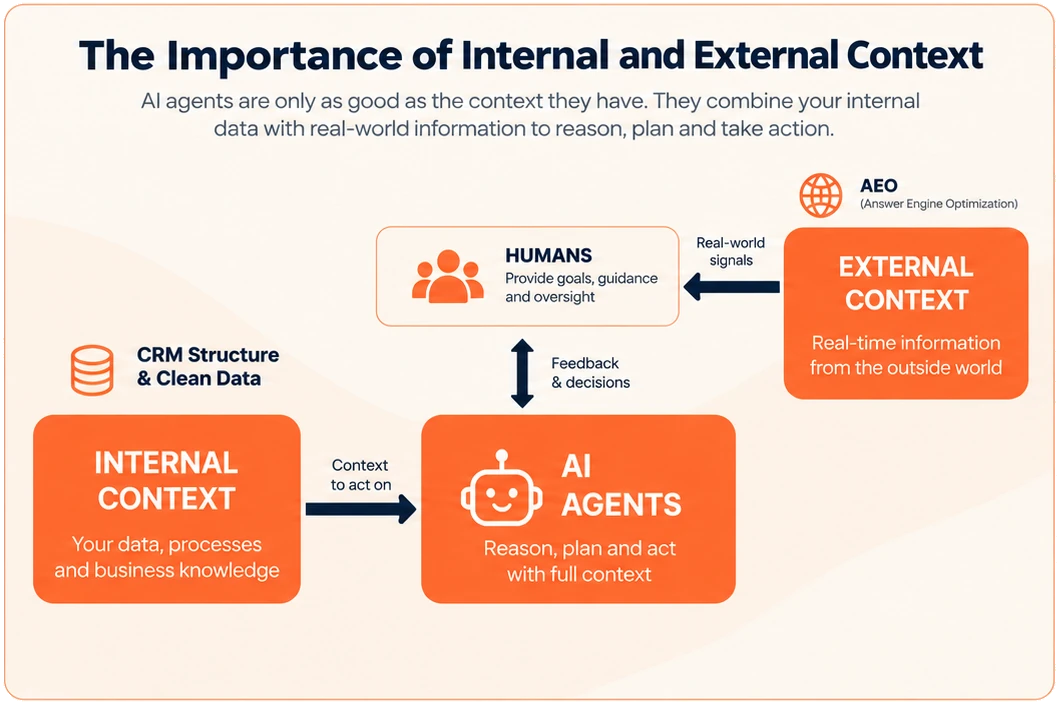
AI agents don't run on intelligence alone. To reason, plan and act, they combine two kinds of context — and most businesses are weak on at least one of them.
Your data, processes and business knowledge. Clean structure gives an agent context it can act on; messy data gives it the confidence to be wrong.
Real-time information from the outside world: your website, reviews, news, social and what others say about you. Answer Engine Optimisation makes sure that picture is accurate and easy for AI to find.
People still set the goals, provide guidance and oversee the decisions. The aim is better-informed agents, not unsupervised ones.
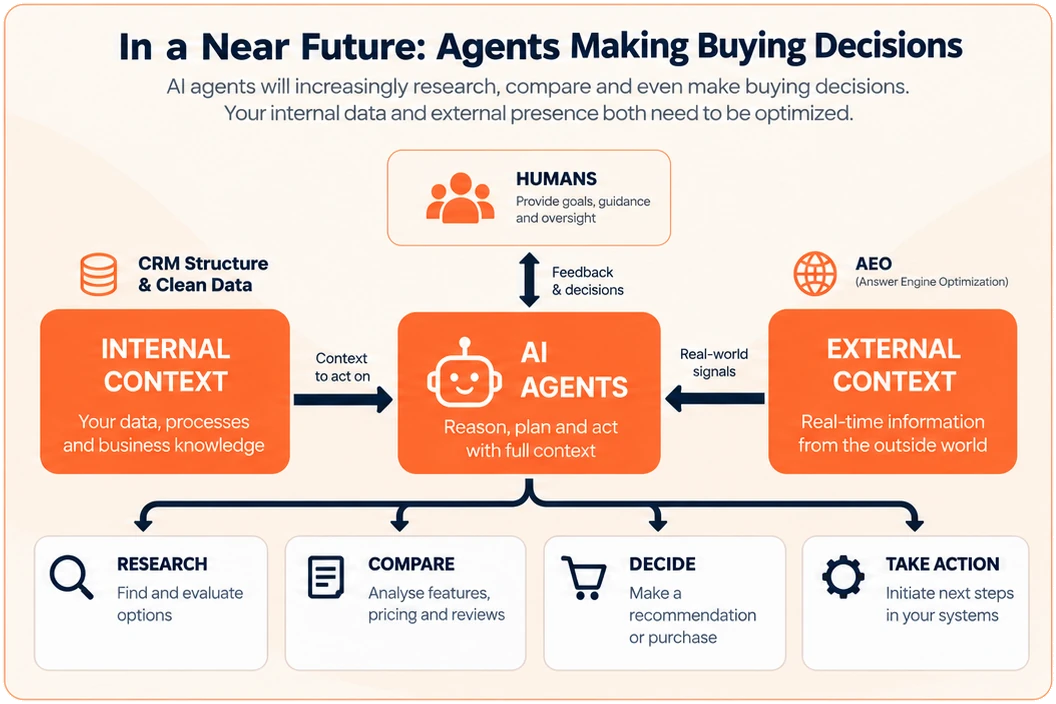
The same agents won't stop at answering questions. They'll research, compare and act on a buyer's behalf — and Gartner predicts that by 2028, 90% of B2B buying will be AI-agent intermediated, pushing over $15 trillion of B2B spend through AI agent exchanges.
AEO and AI-ready revenue operations both take time to build — and both compound. The businesses that start now are the ones agents will understand, trust and recommend.
Answer Engine Optimisation is the practice of improving how often — and how accurately — your business appears in AI-generated answers on platforms like ChatGPT, Perplexity and Google's AI Overviews.
Answer engines weigh your own content alongside reviews, news, social and how others describe you before deciding who to mention and cite. If that picture is thin, inconsistent or out of date, so is the answer a buyer gets.
of B2B buying predicted to be AI-agent intermediated by 2028
Gartner, Top Predictions for 2026 and BeyondIf your CRM can't tell an agent what a field means, which record is current or who owns an account, it guesses. Fixing structure and data quality now is what makes every AI tool you add later actually useful.
Clear, consistent facts about your business — on your site and across the web — are what get you into AI answers. That kind of authority takes months to build, not days.
Agents do their best work when internal and external context line up: your CRM knows the customer, and the web tells the truth about you. Build both, and you're ready for buyers who hand the shortlist to an agent.
Could an AI safely treat your CRM as business memory? If an assistant were connected today, would it understand what every field means, find the right records, know which data to trust and whether it's current — and keep to what each person may see?
Your AI-Native CRM Readiness is scored out of 100. Half is AI Data Readiness — is the CRM fit to be an AI's memory? Half is AI Answer Reliability — would real business questions get reliable answers?
Alongside the score comes a straight verdict on the question that matters most: could you plug an AI assistant in right now?
Use AI to draft and summarise, not to answer from the CRM unchecked — it can't tell what many fields mean, and would be confidently wrong where the records are thin.
Each category is weighted by how much it matters to an AI. Semantic clarity carries the most, because an AI that can't tell what a field means can't use it. Every score opens up to show the checks behind it, alongside an AI data dictionary for the whole CRM.
Each check is measured against the bar published guidance sets for HubSpot's own AI agents and for connecting tools like Claude. Every bar shows where the account is now — and where it needs to be.
Anything that can't be checked automatically is flagged as not checked, never quietly counted as a pass.
AI asks the questions your team would actually ask, and the audit checks every relevant record for what a reliable answer needs. You can set up your own questions too.
Swipe to see every measure
| Question | Accuracy25% | Completeness20% | Freshness15% | Correct refusal15% | Permission compliance15% | Source citation10% | Score |
|---|---|---|---|---|---|---|---|
| “What active opportunities do we have with a company?”8,412 companies | 88 | 92 | 6 | 81 | 64 | 90 | 72 |
| “When did we last speak to a company?”8,412 companies | 79 | 18 | 24 | 90 | 38 | 46 | 51 |
| “Why did this deal stall?”316 stalled and lost deals | 27 | 22 | 57 | 66 | 0 | 12 | 31 |
| “Who is our main contact at a company, and who owns the account?”8,412 companies | 39 | 21 | 26 | 31 | 31 | 25 | 30 |
| “Do we have any open issues with a company?”8,412 companies | 22 | 12 | 92 | 22 | 12 | 12 | 28 |
| Across the questions tested | 51 | 33 | 41 | 58 | 29 | 37 | 42 |
Every gap is ranked by the points it would add to your overall score once fixed — so the first fixes are the ones that move the needle.
Then the audit runs again, month by month, so progress is measured rather than assumed.
Would it have the whole picture?
110 of 612 custom properties described — 18% once weighted by use
Could it keep to what the person asking may see?
Can an AI tell what happened, when, and whether it's still current?
164 likely duplicate pairs — an AI can't tell which is the real one
All scores and figures shown on this page are example data for illustration.
Three simple steps to a clear picture of how ready your CRM is for AI.
Secure, read-only access to your HubSpot. Nothing in your CRM is changed.
AI asks the questions your team would ask of every company, deal and contact — and checks whether HubSpot holds what a reliable answer needs.
Your AI-Native CRM Readiness out of 100, across nine data categories and six answer measures — with a straight verdict on whether you're ready.
Every fix is ranked by the impact it would have, so you can prioritise and work through them yourself, or work with us and we'll go through the fixes together.
With the foundations fixed, your revenue operations become something AI can safely work from.